Exploring Workplace Analytics and Insights Platforms
Workplace analytics platforms can help people and organizations understand patterns in meetings, focus time, collaboration, and wellbeing. The same data can also feel intrusive or become harmful if an insight is treated as a judgement about an individual.
Begin with a beneficial purpose
The first question is not which activity signals are available. It is which outcome the product is trying to support.
Examples might include:
- Helping an individual protect focus time or reduce meeting overload
- Showing a team how collaboration patterns change
- Helping leaders notice broad organizational friction
- Evaluating whether a work practice improves wellbeing or effectiveness
The platform should not quietly turn activity into a productivity score. Sending messages, attending meetings, and working long hours are observable behaviors, not complete measures of value, effort, or performance.
Separate personal, team, and organizational insights
These views have different audiences and privacy expectations.
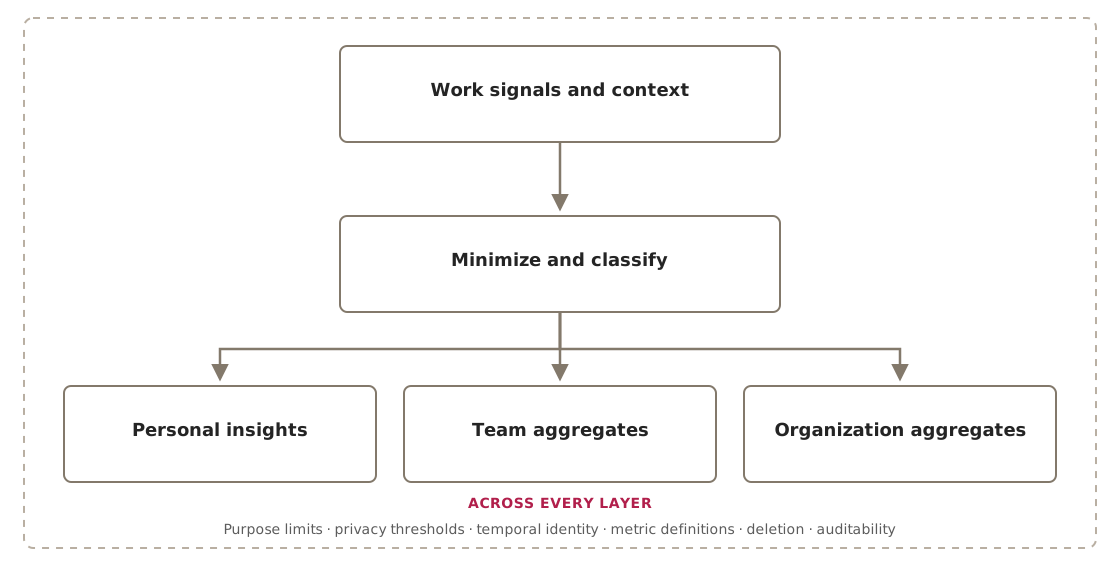
A personal insight can use information visible only to that person. A manager or organizational view should rely on aggregation, minimum group sizes, and policies that prevent drilling down to an individual.
The product needs to resist reconstruction. An aggregated group can still reveal one person if filters allow repeated subtraction across teams, dates, or attributes.
Define every metric precisely
Terms such as focus time, work outside scheduled hours, meeting load, collaboration, and network size sound intuitive but depend on choices.
- Which calendar and communication events count?
- How are time zones, work schedules, leave, and reduced hour arrangements handled?
- Does an accepted meeting mean attendance?
- How are recurring events, large meetings, and tentative responses treated?
- When is an interaction internal, external, synchronous, or asynchronous?
- What period and population form the baseline?
The UI should explain the definition, time range, freshness, and important limitations near the insight. A metric without context invites a stronger conclusion than the data supports.
The data pipeline must preserve privacy intent
Workplace analytics can combine calendar, email, chat, meeting, directory, survey, and organizational data. Each source has its own permissions, retention, and meaning.
Approved sources → Identity and organization mapping
                         ↓
                Minimize and normalize
                         ↓
           Compute measures and aggregates
                         ↓
      Privacy checks → Insights → Explanation
The raw content of a message may not be necessary when metadata is enough for the intended measure. Data minimization should happen before storage and enrichment where possible.
Identity and organizational history depend on time. A person's manager, team, role, location, and work schedule can change. Analysis should use the structure applicable to the period being measured rather than today's directory value for every historical event.
One possible implementation
This hypothetical architecture uses publicly documented technologies. It does not describe the implementation of Microsoft Viva Insights or any other Microsoft internal system.
An analytics platform could use Apache Spark for governed batch processing, Delta Lake for versioned analytical data, and PostgreSQL for metric definitions, policy, and product configuration. React and ASP.NET Core could serve personal and aggregate insight experiences through separate authorization paths.
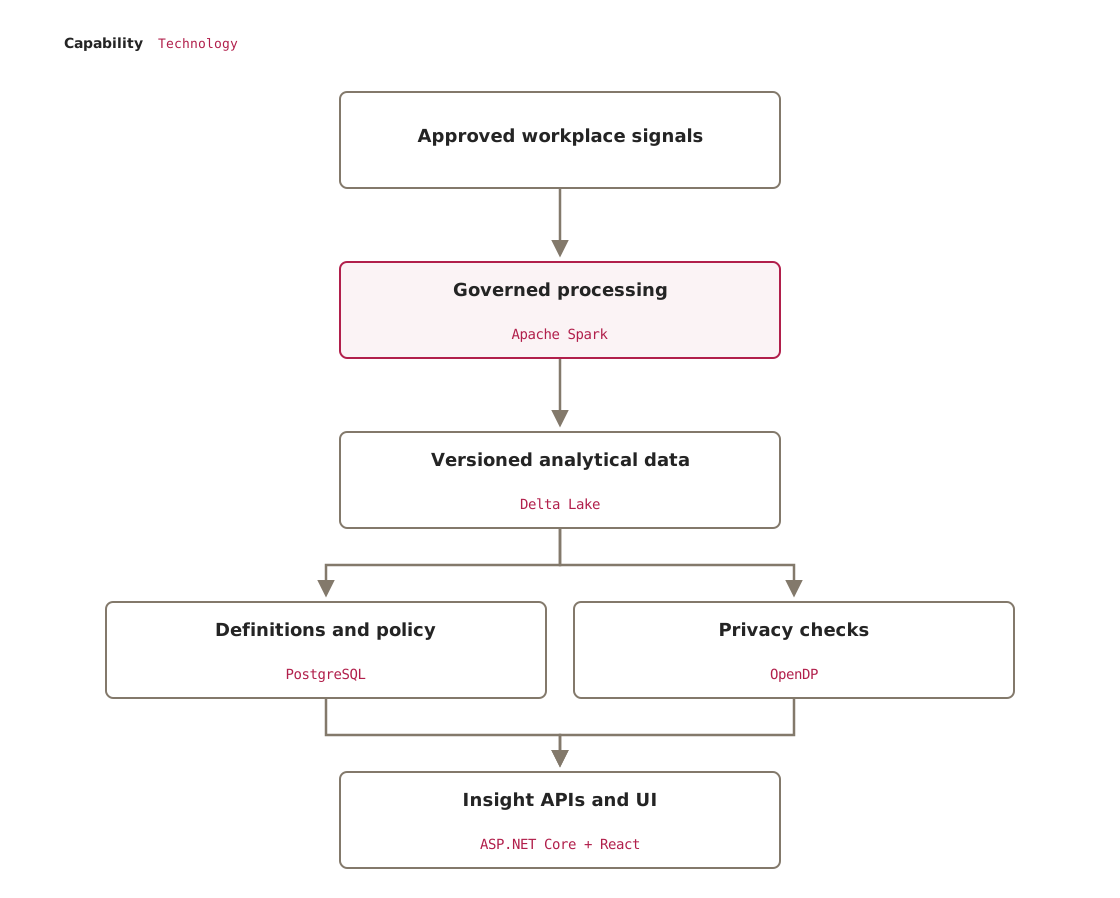
Privacy-preserving releases can use reviewed techniques and libraries such as OpenDP where differential privacy fits the question. Source permissions, temporal organization data, minimum group sizes, purpose limits, and deletion obligations must remain explicit instead of being hidden inside a generic data-lake stack.
Privacy is a system property
Privacy is not achieved by removing names at the final dashboard. It needs controls throughout collection, processing, storage, querying, export, support, and deletion.
Useful protections include:
- Purpose limitation and documented data classification
- Tenant isolation and access limited to what each role requires
- Minimum aggregation thresholds
- Suppression of small or sparse groups
- Restricted filtering and export combinations
- Audit records for administrative and analytical access
- Retention, deletion, and regional processing rules
- Review for new metrics and secondary uses
Pseudonymous records can still be personal data when they can be linked back to a person. Aggregation reduces risk but does not automatically eliminate it.
A notice alone does not provide consent or transparency
People should understand which signals are used, what is calculated, who can see each result, how long data is retained, and what choices are available.
The power relationship at work complicates consent. An employee may not feel free to refuse an organizational tool. This makes necessity, proportionality, governance, access restrictions, and independent review especially important.
Insights should not become performance verdicts
Work patterns are influenced by role, seniority, caregiving, geography, disability, culture, customer needs, and organizational structure. A pattern that suggests overload for one person may be normal or chosen for another.
I want insights to use language such as “you may want to review” rather than claiming a diagnosis. Recommendations should allow dismissal, correction, and personalization.
For organizational insights, the product should emphasize systems and practices instead of ranking individuals. It can ask whether meetings are concentrated, collaboration crosses boundaries, or focus time is fragmented without declaring who is productive.
Statistical quality matters
An attractive chart can hide unstable data. The platform should account for sample size, missing data, selection bias, seasonality, organizational changes, and multiple comparisons.
Trends need suitable baselines and uncertainty. A change after a new policy does not prove that the policy caused it. Experiments and surveys can add context, but they introduce their own participation and interpretation biases.
Metric changes require versioning. Historical comparisons become misleading if the definition changes without a visible break or recalculation policy.
Security includes administrators and analysts
Workplace data can reveal reporting relationships, communication patterns, sensitive projects, and periods of absence. Administrative tools, exports, APIs, notebooks, and support access need strong authorization and audit history.
Queries should prevent access across tenants and unsafe joins. Exports deserve additional controls because they can outlive dashboard restrictions.
Reliability includes freshness and completeness
Delayed ingestion, directory mismatches, service outages, and changes to source policy can make an insight incomplete. The platform should show freshness and avoid generating strong recommendations from partial data.
Operational signals include source coverage, processing delay, identity mapping failures, aggregation suppression, metric computation errors, and delivery success. A missing insight should be distinguishable from “nothing unusual happened.”
What changes with AI agents
An agent could explain a personal pattern, help reorganize a calendar, summarize organizational findings, or propose ways to protect focus time. Natural language can make analytics more accessible, but it can also make weak inferences sound confident and personal.
An agent should retrieve only insights the current user is authorized to see. It should not bypass aggregation thresholds by asking the same question in several ways. Generated explanations need the metric definition, time range, source, and limitations.
Actions such as declining meetings, changing work hours, messaging colleagues, or creating team policies should be proposed rather than silently executed. Personal coaching should remain private unless the user deliberately shares it.
Prompt and tool logs must not become a new store of sensitive workplace data. Retention, redaction, use by model providers, and access need the same governance as the analytics platform.
Try the privacy threshold experiment
The aggregate insight lab is a working prototype that hides an insight for a group below the privacy threshold and publishes it only after the cohort is large enough. It links to free privacy-framework and differential-privacy resources.
Questions I am wondering about
- What beneficial purpose justifies each signal and metric?
- Can filtering or repeated queries reveal an individual?
- Are metric definitions, freshness, and limitations understandable?
- How are organizational history, time zones, leave, and work patterns represented?
- Could the insight be misused for performance evaluation or surveillance?
- How are small samples, missing data, bias, and metric changes handled?
- Which users can query, export, administer, or support the data?
- Can a person correct, dismiss, or meaningfully act on an insight?
- Does an AI explanation preserve privacy boundaries and uncertainty?
What I want to remember
Workplace analytics should help people and organizations reflect, not turn human work into a score. Useful insights depend on careful metric definitions, strong privacy boundaries, statistical humility, transparency, and respect for the people whose activity creates the data.