Exploring Online Marketplaces
Marketplaces coordinate independent buyers and sellers while the platform manages discovery, trust, transactions, disputes, and incentives. The difficult part is not listing supply. It is creating rules that remain fair when participants have different information and goals.
Model both sides and the platform
Listings, offers, orders, fulfillment, acceptance, payout, returns, and disputes need explicit states. The platform may facilitate a transaction without owning the goods or service, which makes responsibility and communication especially important.
Seller supply → Discovery → Buyer intent → Transaction → Fulfillment → Payout
                                    ↓             ↓
                                  Cancel       Dispute
A reference architecture
Marketplaces differ by goods, services, fulfillment, and payment responsibility. Common boundaries include:
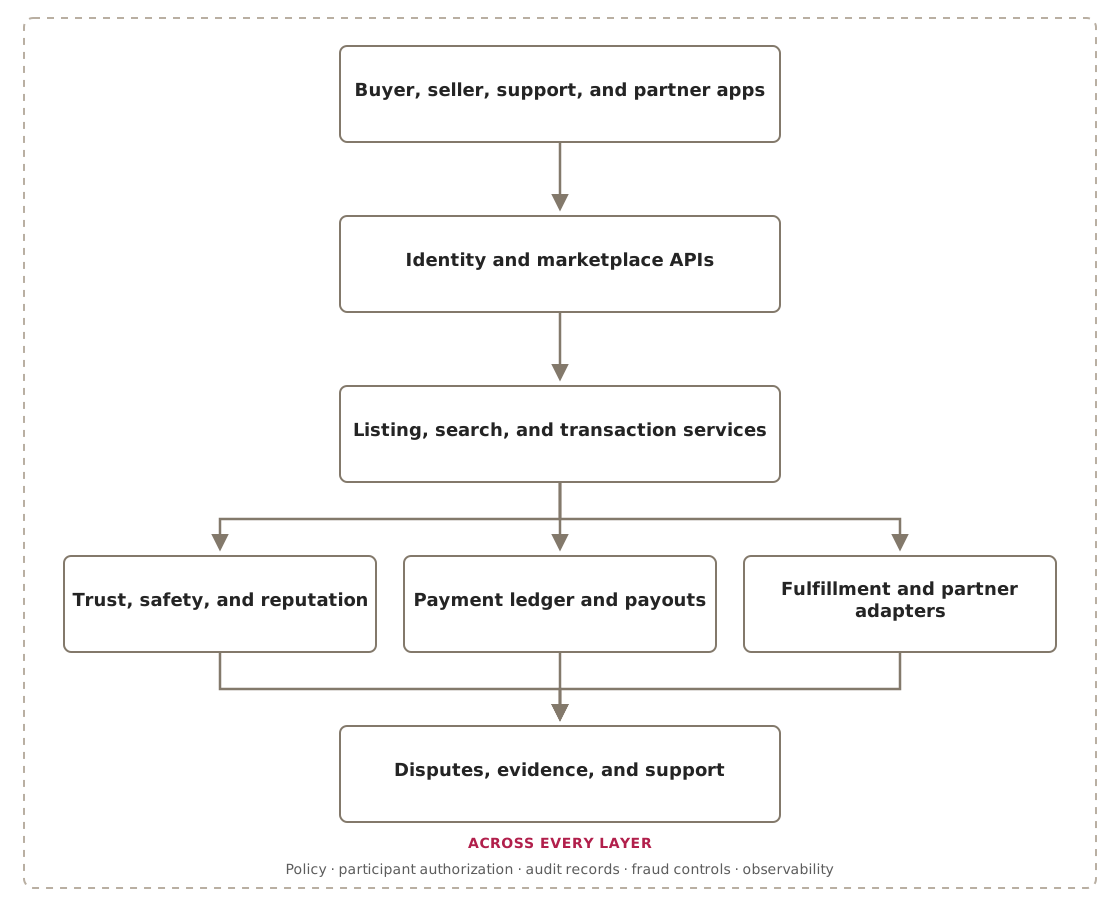
Search may use indexed copies, but price, availability, eligibility, and policy must be checked again by the transaction service before commitment.
One possible implementation
A marketplace could use Next.js for buyer and seller experiences, Kotlin with Spring Boot for transaction services, PostgreSQL for listings, orders, and ledger records, and OpenSearch for discovery. Apache Kafka can distribute committed order, fulfillment, moderation, and payout events.
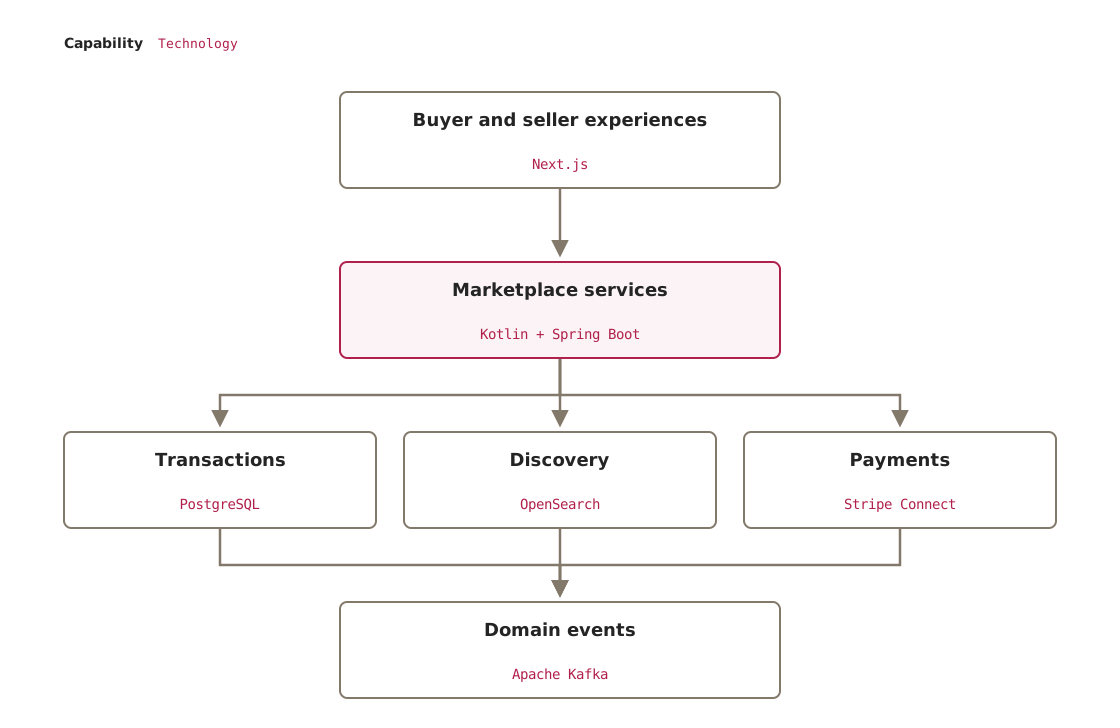
A connected-account product such as Stripe Connect may handle payment onboarding and payouts, but platform records still need reconciliation with provider results. Search scale, local payment methods, evidence retention, and the platform's legal role should decide where managed providers end and owned workflows begin.
Trust is built from evidence
Identity checks, listing verification, reputation, reviews, guarantees, moderation, and support each provide partial evidence. None should be treated as perfect.
Reviews need policies for eligibility, manipulation, retaliation, removal, and appeals. Reputation should not trap new participants or make one disputed event impossible to recover from.
Search and ranking shape the market
Ranking affects who receives attention and income. Relevance, quality, price, distance, availability, sponsored placement, and platform incentives should be distinguishable.
Measure outcomes across participant groups and monitor feedback loops. A ranking model trained only on prior conversion can repeatedly favor already successful sellers.
Money must match the transaction state
Authorization, escrow or delayed capture, fees, taxes, refunds, chargebacks, credits, and seller payouts need a reconciled ledger. The system should define when the platform considers each party's obligation complete.
Idempotency protects retries. Reserves and delayed payouts may control risk, but their rules and impact on legitimate sellers need visibility.
Fraud, abuse, and disputes are core workflows
Marketplaces face fake listings, stolen accounts, payment fraud, collusion, attempts to move transactions outside the platform, prohibited goods, review manipulation, and abusive communication.
Controls need progressive responses, evidence preservation, human review, and appeals. Support agents require tools that show the whole transaction without granting unnecessary access.
Liquidity and scale are local
A marketplace can look large globally and still fail in one category or city. Useful measures include search success, time to match, fulfillment, cancellation, repeat participation, dispute rate, and concentration.
Caching and search indexes help discovery, but price, availability, eligibility, and policy must be revalidated before commitment.
What changes with AI agents
Buyer agents may search and negotiate while seller agents manage listings and prices. This can reduce effort, but it can also create automated scraping at high speed, collusion, price spirals, and a market where people cannot understand why an outcome occurred.
Agent contracts need identity, quotas, disclosure, bounded negotiation authority, and confirmation thresholds. The platform should preserve an offer, fee breakdown, terms, and evidence trail that a person can read.
Ranking and fraud systems must distinguish helpful automation from manipulation without requiring every participant to use the same agent provider.
Try the marketplace escrow experiment
The escrow workflow lab is a working prototype that holds buyer funds, blocks an early seller payout, records fulfillment, and then releases the money. It uses mock balances and requires no payment account.
Questions I am wondering about
- What does the platform promise to buyers and sellers?
- When are funds captured, released, reserved, refunded, and reconciled?
- How are rankings, sponsorships, and policy decisions explained?
- What evidence supports reputation, moderation, and disputes?
- Where is liquidity weak or concentrated despite healthy totals?
- How will buyer and seller agents change fairness and abuse?
What I want to remember
A marketplace is a governed economy rather than a database of listings. Architecture, policy, ranking, money movement, and support affect whether participants can trust the exchange.