Exploring Online Games and Virtual Economies
Online games combine live simulation, player identity, progression, matchmaking, social systems, live content, and sometimes economies with real value. The design must preserve fun and fairness while operating under hostile clients and unpredictable global demand.
Note: These are exploratory system design notes. I have not built a production online game. I am using this architecture as a map for learning and future experiments.
Player input → Authoritative session → Result and progression
Player input → Client prediction
Authoritative session → Matchmaking
Result and progression → Economy ledger
A reference architecture
Game architecture depends on genre, platform, and latency needs. This view shows common online service boundaries:
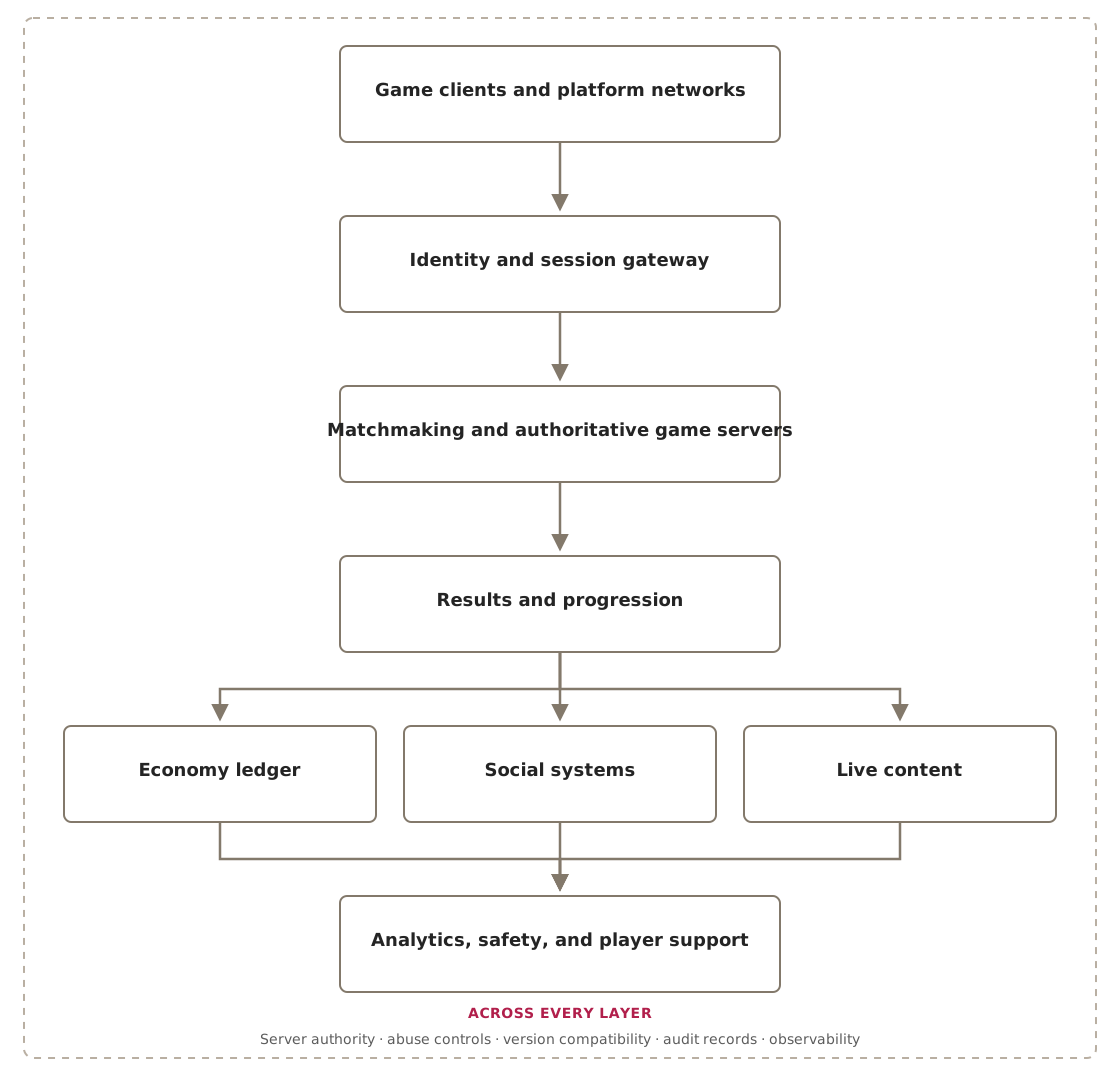
The client can predict visual results for responsiveness, but protected outcomes, rewards, inventory, and purchases must be committed by trusted servers.
One possible implementation
A game client might use Unity, with authoritative session servers written in Go and hosted through Agones when dedicated server orchestration is needed. Open Match can support customizable matchmaking, while Redis can hold short-lived session state and PostgreSQL can preserve progression and economy records.
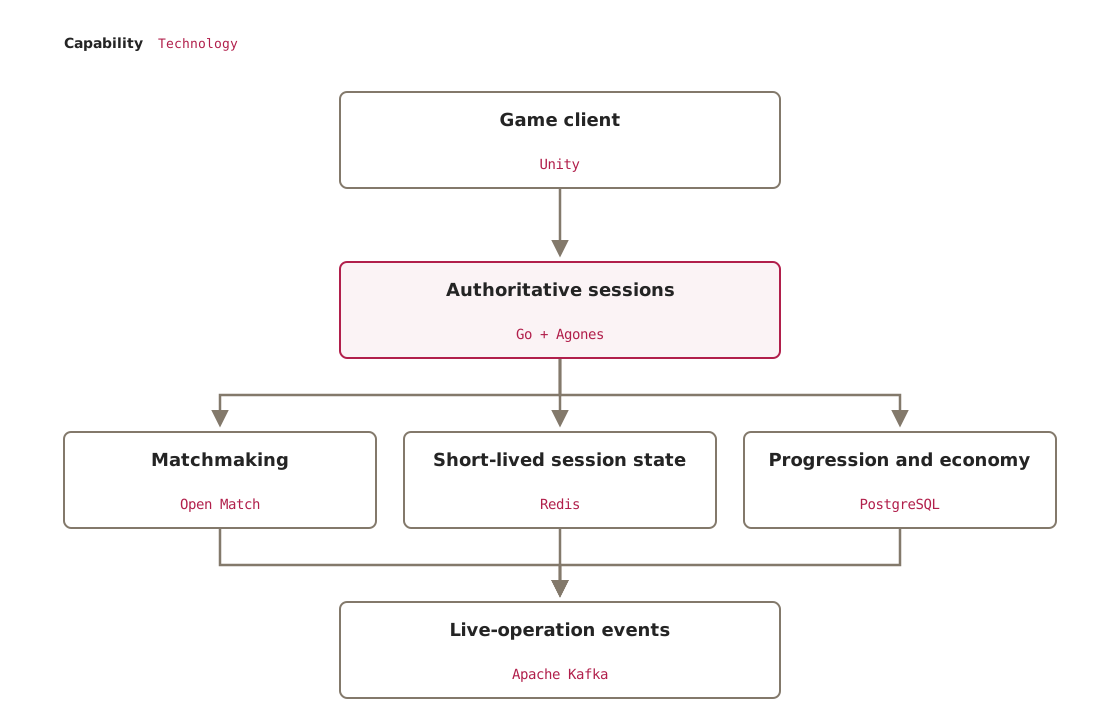
Analytics and live-operation events can flow through Apache Kafka without becoming authoritative gameplay state. Genre, tick rate, platform requirements, cheating risks, and regional latency should determine the transport and server model before infrastructure products are selected.
Decide what the server must own
Clients need responsiveness, but a client controlled by the player cannot be trusted with authoritative outcomes. Server authority commonly covers inventory, progression, purchases, matchmaking, and competitive simulation.
Client prediction and reconciliation can hide latency without allowing the client to decide truth. The acceptable balance depends on genre and consequence.
Matchmaking is a product policy
Skill, latency, party size, role, wait time, region, input method, and player behavior can all affect a match. Optimizing one measure can harm another.
The system needs widening rules, backfill, rematches, cancellation, and honest measurement across cohorts. A fast unfair match and a perfect match that never starts both fail.
Live sessions need failure rules
Tick rate, bandwidth, state replication, lag compensation, reconnect, host migration, and regional placement affect play. The game must define what happens when one player disconnects, a server crashes, or versions differ.
Results should be committed idempotently so a retry cannot grant rewards twice.
Virtual economies need ledger thinking
Currency, items, crafting, trading, rewards, and purchases create sources and sinks. Every valuable change needs a durable reason and protection from duplication.
Economy telemetry should detect inflation, concentration, exploits, and unintended loops. Rollbacks and compensation need care because they affect real player effort.
Fair play and safety are continuous work
Cheat prevention combines server validation, telemetry, detection, device signals, and investigation. Bans need confidence, proportional responses, and appeals.
Chat, names, content created by users, minors, harassment, and reporting require moderation and privacy controls. Safety should not depend on recording more personal data than necessary.
Live operations change the architecture
Events, seasons, experiments, configuration, and content delivery should roll out without requiring every client to update at once. Version compatibility, feature flags, kill switches, and regional capacity protect launches.
What changes with AI agents
AI can power characters, coaching, moderation assistance, content tools, or player support. Generated behavior needs latency and cost budgets, boundaries suitable for the player's age, safety evaluation, and deterministic limits around rewards or competitive outcomes.
Player agents that automate play can become accessibility aids, bots, or cheats depending on context. The rules must state what automation is allowed and enforce it consistently.
Try the authoritative movement experiment
The server movement lab is a working prototype that accepts a legal movement input but rejects an impossible client teleport without changing authoritative state. It includes free Godot and Nakama resources for taking the idea further.
Questions I am wondering about
- Which state is authoritative, and how is latency hidden safely?
- What does matchmaking optimize, and who is disadvantaged?
- How are results, rewards, and purchases committed exactly once in intent?
- Can the economy explain every source and sink of value?
- How are cheating, moderation, and appeals handled?
- Where does AI improve play without deciding protected outcomes?
What I want to remember
Game architecture serves an experience. Reliability, authority, economies, safety, and live operations matter because they protect fairness, continuity, and the player's willingness to invest time.