Exploring Logistics and Delivery Systems
Logistics systems coordinate orders, inventory, warehouses, vehicles, routes, carriers, and people across the physical world. Their data is always an imperfect representation of items that can be delayed, damaged, misplaced, or scanned out of order.
Model custody and movement
An item moves through planned and observed states. The system should record who had custody, where, when, and based on which scan or event.
Ordered → Allocated → Picked → Packed → Dispatched → Delivered
                         ↓          ↓           ↓
                      Shortage    Damage      Exception
Events can arrive late or twice. State derivation needs ordering rules, idempotency, and a path for correction without deleting history.
A reference architecture
Logistics networks differ by goods, geography, carriers, and operating model. A common component view is:
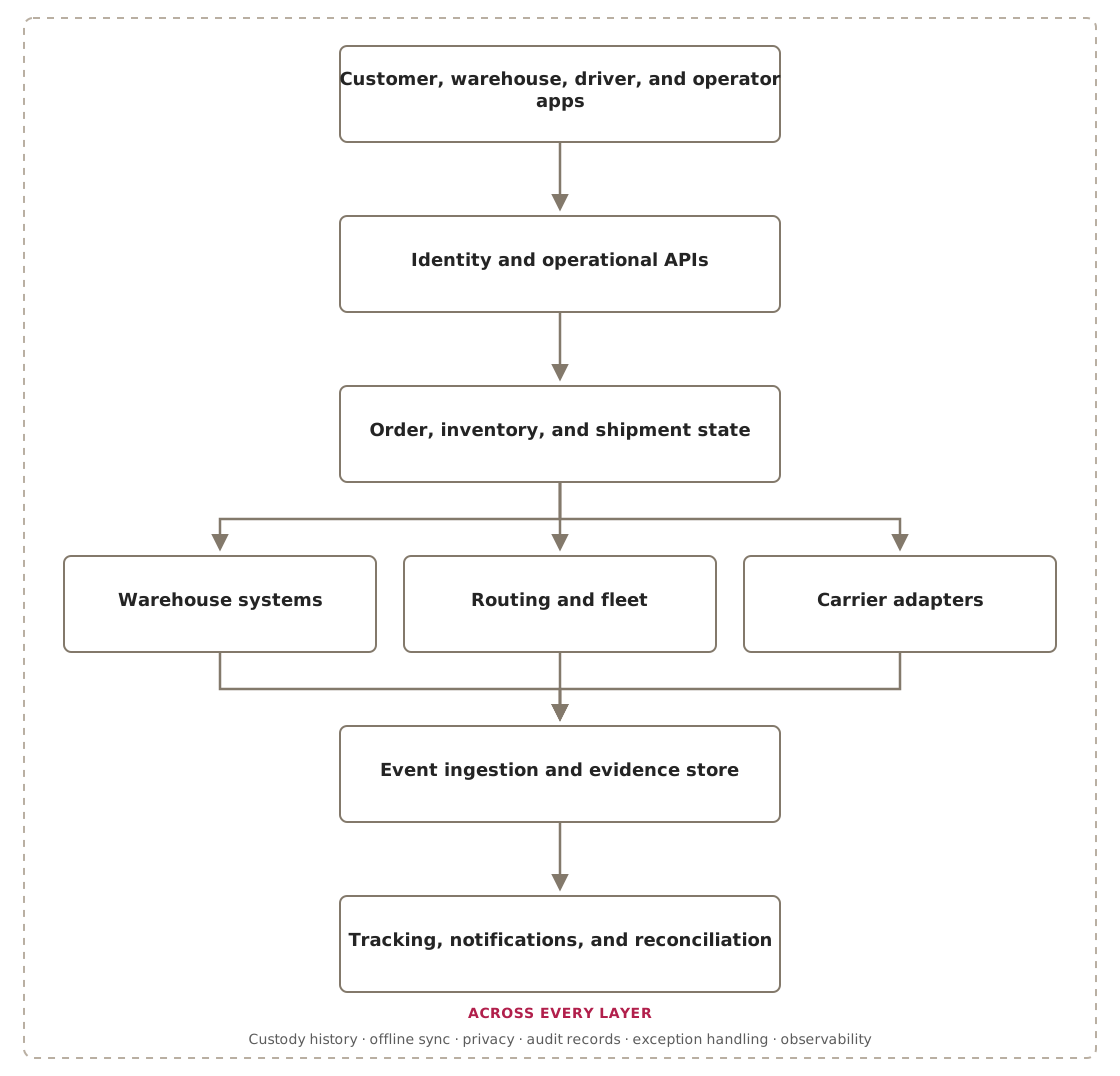
Scans and device signals provide evidence, while the shipment service derives the status shown to users. Partner records require reconciliation when they arrive late or disagree.
One possible implementation
Warehouse and driver clients could use React Native with a local database for offline scans, while Kotlin and Spring Boot services manage orders, custody, and shipment state. PostgreSQL with PostGIS can hold operational and geographic data, and Apache Kafka can carry scans and partner events.
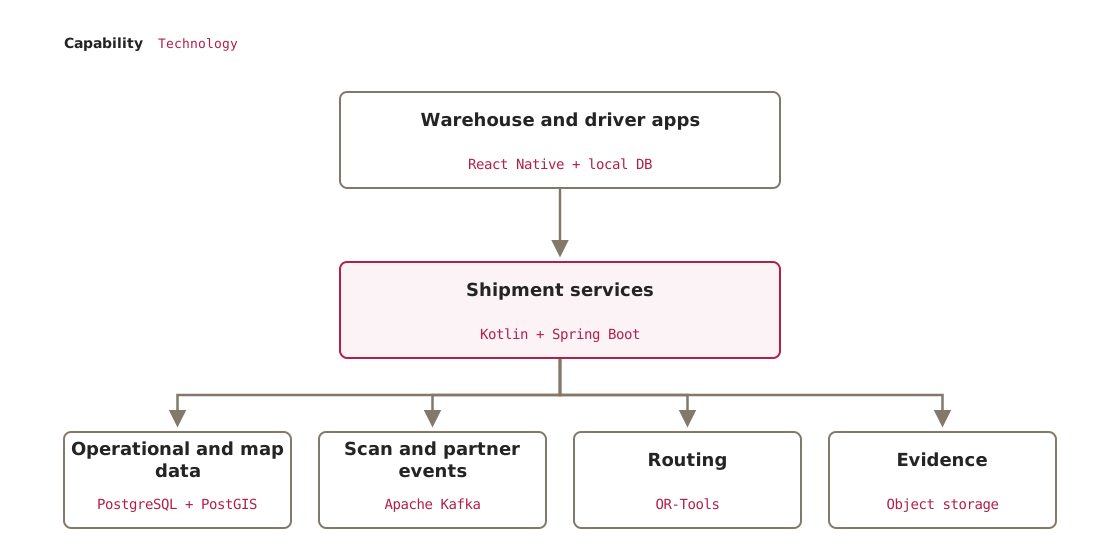
OR-Tools can provide established routing and scheduling algorithms, with object storage retaining labels, photos, and delivery evidence. Offline conflict rules, event identity, partner compatibility, and operational recovery are more important than using the same technology at the edge and in the cloud.
Inventory accuracy is a continuous process
Available, reserved, physically present, damaged, moving between locations, and expected inventory are different quantities. Allocation needs one authoritative policy under concurrent orders.
Cycle counts, scan discrepancies, returns, substitutions, and reconciliation keep the digital record aligned with the warehouse.
Routing combines optimization and reality
Plans consider capacity, time windows, traffic, driver hours, service time, geography, priority, and cost. A mathematically efficient route may be operationally impossible.
Replanning should limit disruption and explain changes. Estimates need confidence ranges and should improve from actual pickup, handling, and delivery data.
Offline work is normal
Warehouses, roads, and remote sites may lose connectivity. Devices need durable local state, clear synchronization, conflict handling, and secure recovery if lost.
Barcode, RFID, GPS, temperature, and delivery evidence have different accuracy and trust. Raw evidence and derived status should remain distinguishable.
Integrations form a changing network
Carriers, merchants, customs, maps, payments, and customer systems use different identifiers and event meanings. Adapters, canonical references, schema versioning, retries, and reconciliation contain that variation.
Safety and privacy cross the physical boundary
Driver location, customer addresses, access instructions, signatures, and images need limited access and retention. Route optimization must not create unsafe schedules or hide legally required breaks.
What changes with AI agents
Agents may investigate exceptions, contact partners, rebook a carrier, or propose a new route. They can reduce coordination work, but they should not invent a delivery state or overwrite physical evidence.
Actions need bounded cost, approved partners, confirmation thresholds, and an audit trail connecting the exception to the chosen response. Human operators need a map and timeline to understand and override the plan.
Try the custody chain experiment
The package custody lab is a working prototype that rejects delivery before pickup and records each valid transfer of physical custody. It runs locally and links to free routing and observability resources.
Questions I am wondering about
- Which events prove custody, inventory, and delivery?
- How are late, duplicate, conflicting, and missing scans handled?
- Can critical work continue offline and reconcile safely?
- How does routing account for safety and operational constraints?
- Which partner is authoritative when records disagree?
- Which exceptions may an agent resolve, and within what limits?
What I want to remember
Logistics software cannot make the physical world deterministic. It can preserve evidence, surface uncertainty, coordinate recovery, and help people make better decisions when the plan and reality diverge.