Exploring Healthcare Systems
Healthcare software supports decisions whose consequences can extend beyond the screen. Patient portals, telemedicine, pharmacy, scheduling, and clinical systems must preserve safety, privacy, context, and continuity while fitting real clinical work.
Patient → Care team → Clinical record → Orders and results
Consent, provenance, and continued care → Care workflow
A reference architecture
Healthcare systems differ by care setting, regulation, and existing clinical platforms. This view shows common boundaries:
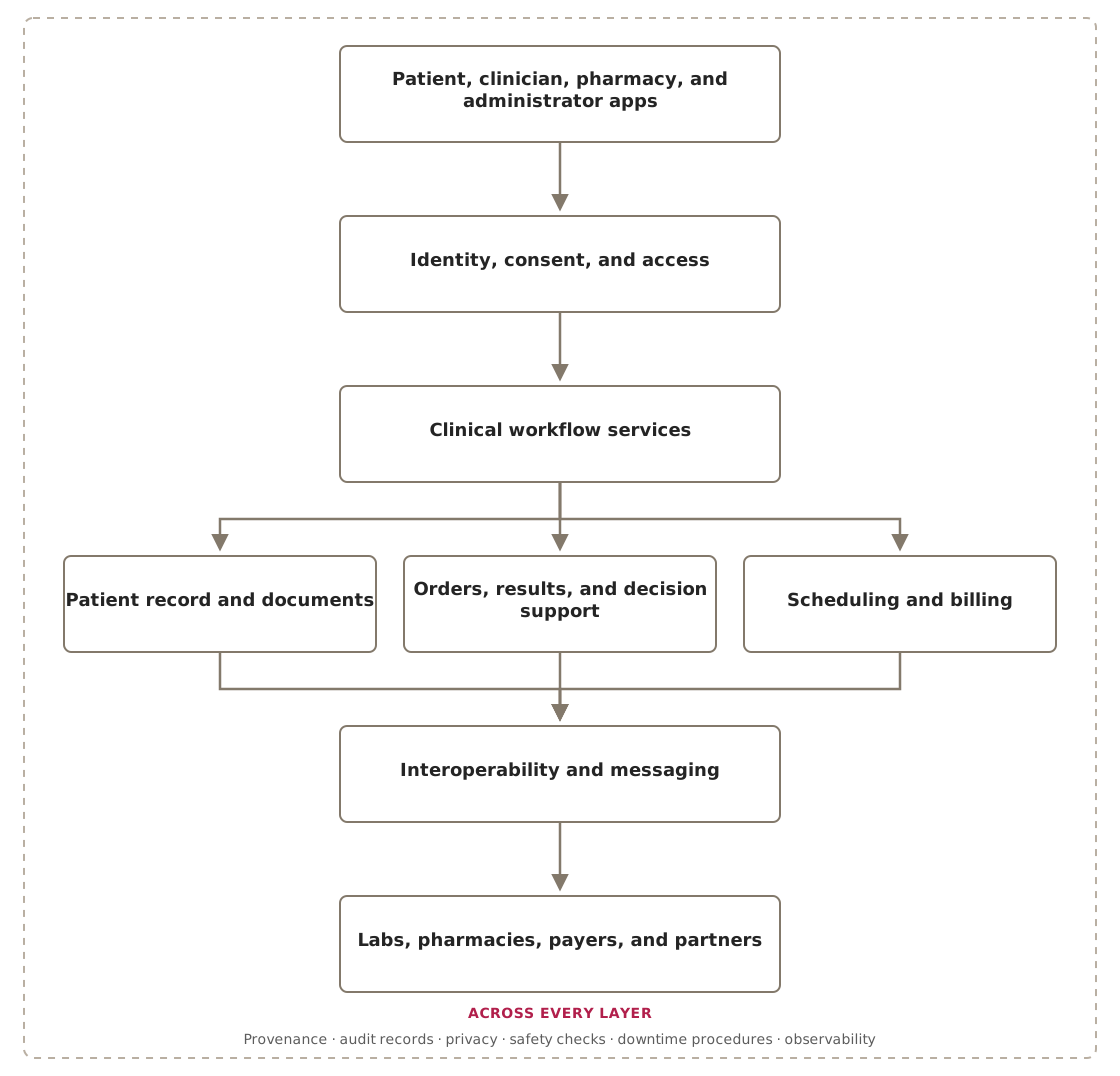
No client or model should bypass clinical authorization or write directly to the patient record. Interfaces must preserve identity, units, source, time, and meaning when data moves between organizations.
One possible implementation
A clinical application could use React for patient and clinician interfaces, Java with Spring Boot for workflow services, PostgreSQL for transactional records, and Apache Kafka for durable integration events. Documents and medical images need protected object storage with lifecycle, provenance, and access auditing.
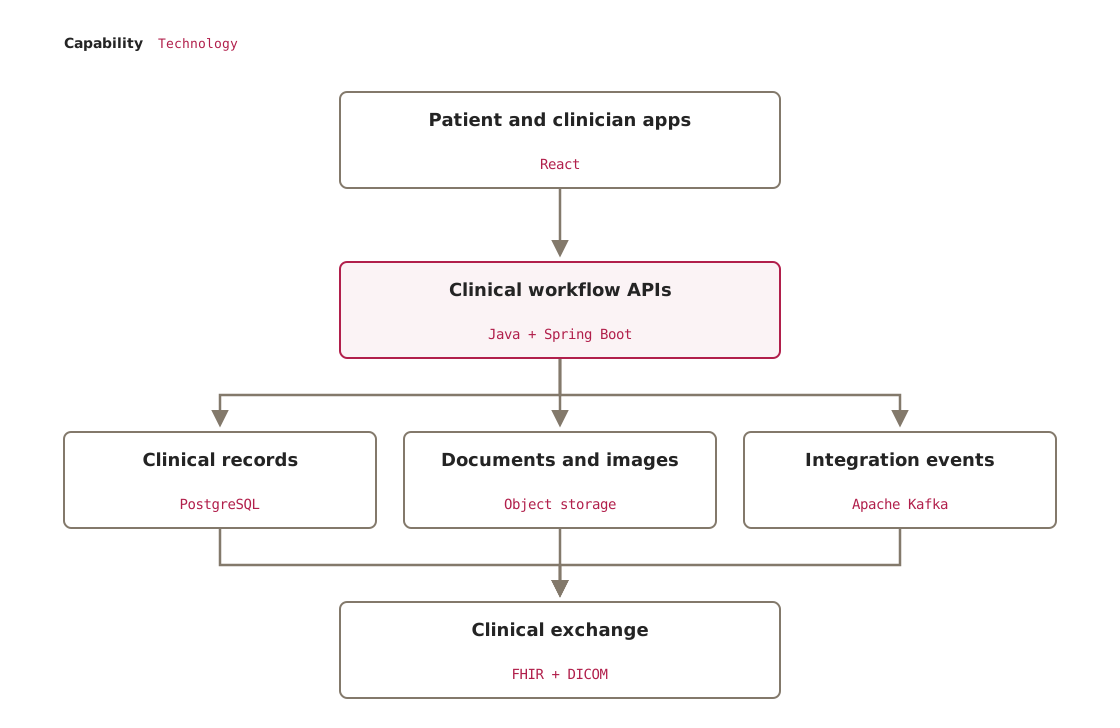
Interoperability should use healthcare standards such as HL7 FHIR and DICOM rather than inventing local meanings for shared clinical data. Existing clinical platforms, regional rules, safety classification, and downtime procedures may constrain the implementation more strongly than any preferred framework.
Begin with the care journey
A useful model follows the patient through registration, consent, assessment, diagnosis, orders, treatment, results, continued care, billing, and record access. Each step has different actors and authority.
Clinical information is not simply CRUD data. A correction may need to preserve the original record, author, time, reason, and downstream recipients.
Separate documentation from decision support
The system may record observations, suggest possibilities, check interactions, or surface guidelines. It should make clear which information came from a person, device, calculation, or model.
Alerts need severity, evidence, ownership, and measurement. Too many alerts with little value create alert fatigue and teach clinicians to ignore the interface.
Identity, consent, and access are contextual
Patients, guardians, clinicians, pharmacists, researchers, support staff, and emergency responders need different access. Authorization may depend on care relationship, purpose, location, consent, and time.
Break glass access can support emergencies, but it needs a reason, prominent audit trail, review, and notification policy. Shared family devices and proxy access deserve deliberate design.
Interoperability needs semantic agreement
Standards can move data between systems, but compatible fields do not guarantee compatible meaning. Units, code systems, reference ranges, patient identity, provenance, and update semantics must be preserved.
Interfaces should tolerate delayed partners and duplicate messages. Reconciliation is necessary when orders, results, prescriptions, or appointments disagree across organizations.
Safety shapes quality and release practices
Tests should cover clinical rules, permissions, units, time zones, duplicate patients, unavailable dependencies, and representative workflows. Changes need traceability from requirement to evidence, with gradual rollout and a rapid disable path.
Downtime procedures are product features. Care may continue when the system is unavailable, so staff need access to view records, printable or offline workflows, and a safe way to reconcile later.
Privacy includes every copy
Notes, messages, images, device data, logs, analytics, search indexes, backups, and model prompts may all contain sensitive information. Collection, purpose, retention, export, correction, and deletion policies need to cover each copy and applicable regulation.
What changes with AI agents
Agents may summarize records, prepare visit notes, explain instructions, schedule care, or help clinicians retrieve evidence. They should preserve citations and uncertainty rather than present generated text as source data.
An agent should not diagnose, prescribe, disclose records, or change an order merely because a model produced a plausible answer. Deterministic authorization, approved data boundaries, human review, and audit history remain outside the model.
Evaluation needs clinically representative cases, subgroup analysis, harmful omission checks, prompt injection tests, and monitoring for automation bias. The interface must let a person inspect sources, correct output, and know when a qualified human is needed.
Try the contextual access experiment
The health record access lab is a working prototype for consent-gated access and an explicit emergency path that creates a mandatory audit review. It runs with mock records and links to free FHIR and OpenMRS resources.
Questions I am wondering about
- Which decisions can harm a patient if data is wrong, late, or missing?
- How are provenance, corrections, consent, and emergency access preserved?
- What happens during downtime and after service returns?
- How are units, identity, and meaning reconciled across partners?
- Which alerts improve outcomes rather than add fatigue?
- Where must an AI suggestion stop and human accountability begin?
What I want to remember
Healthcare systems should support care without hiding uncertainty or erasing context. Safety comes from reliable workflows, meaningful access control, provenance, recovery, and respect for the people represented by the data.