Exploring Enterprise SaaS Products
Enterprise SaaS products support work that crosses teams, permissions, integrations, and records kept for many years. A CRM, HR system, accounting tool, or project platform succeeds when it can adapt to an organization without becoming impossible to understand or upgrade.
Organization → Identity and policy → Configured workflow
Organization → Integrations
Identity and policy → Tenant boundary
Configured workflow → Records and audit
A reference architecture
Enterprise products vary by domain and customer size. This component view highlights common boundaries:
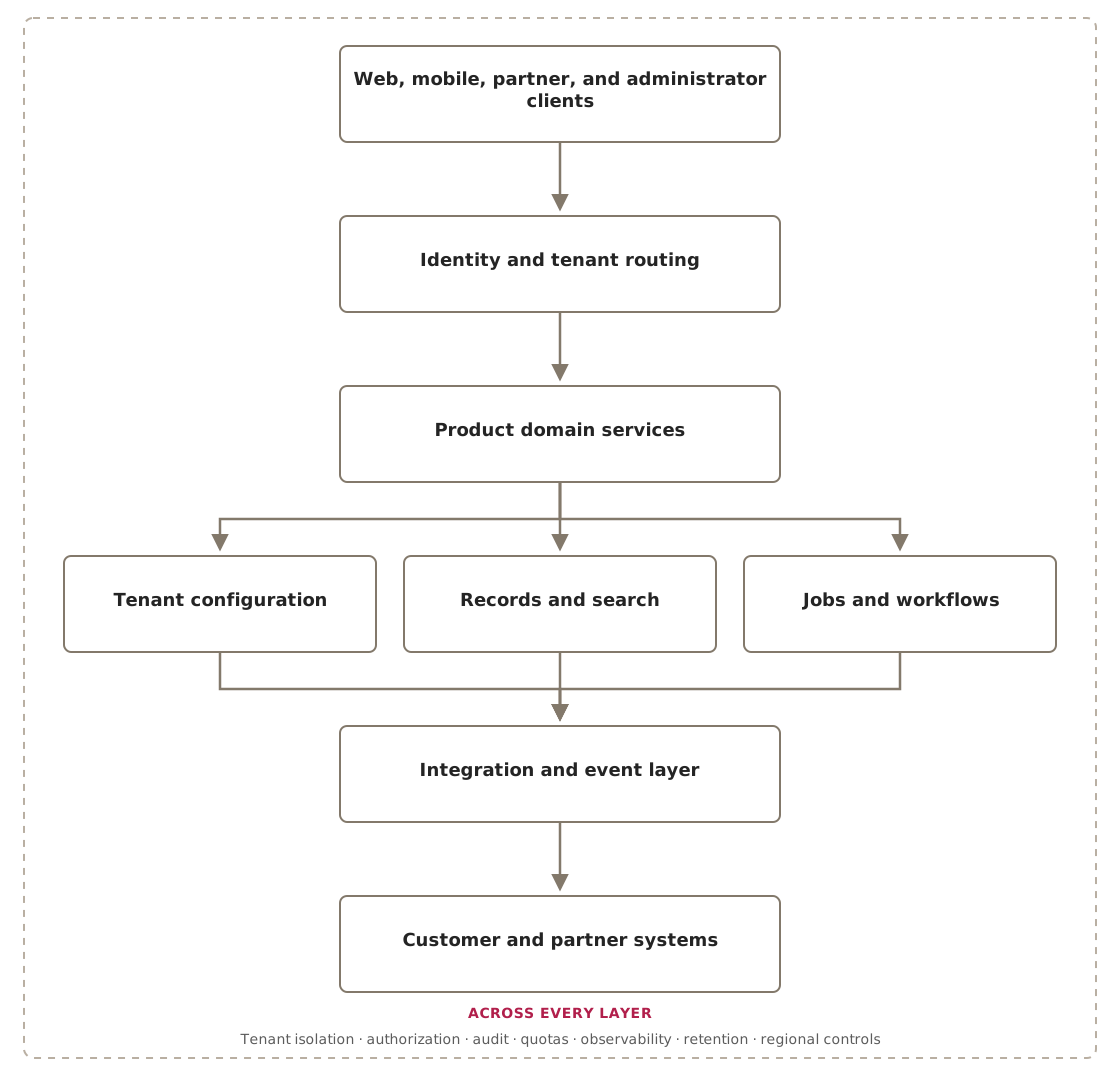
Tenant context must be established before data access and preserved through caches, jobs, search, analytics, exports, and support tools.
One possible implementation
A starting point could use React for the product interface, ASP.NET Core for tenant-aware domain APIs, PostgreSQL for transactional records, Redis for bounded caches, and OpenSearch for permission-filtered search. A durable workflow engine such as Temporal can support approvals, imports, exports, and integration retries.
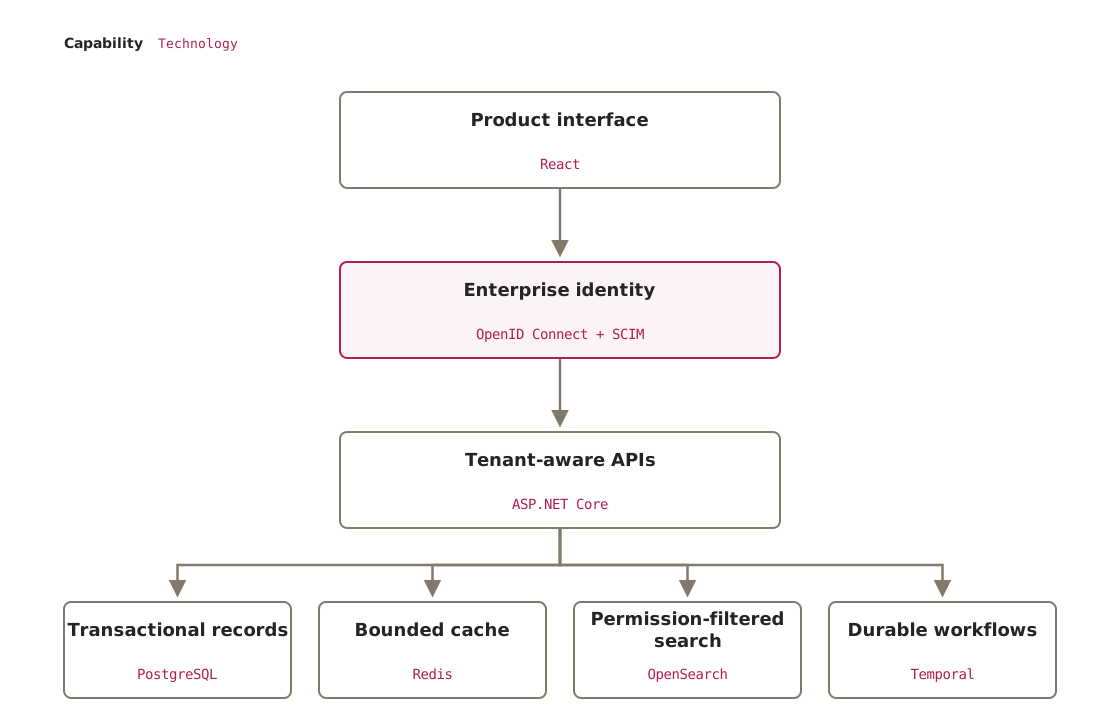
Enterprise identity should use standards such as OpenID Connect and SCIM where customers support them. Tenant isolation, regional placement, extension points, and upgrade compatibility matter more than choosing a separate database or service for every feature.
Tenant isolation extends beyond a tenant ID
Isolation must hold in queries, caches, search, files, background jobs, analytics, logs, exports, and support tools. Large tenants may need separate capacity or data placement without turning the product into unrelated custom deployments.
Tenant lifecycle includes provisioning, configuration, suspension, export, deletion, and restoration. Each needs ownership and audit evidence.
Identity follows the organization
Enterprise products often support single sign on, directory synchronization, groups, service accounts, delegated administration, and automated deprovisioning.
Authorization needs resource scope and action, not only broad roles. Administrators should be able to understand effective access, test policy changes, and recover from a mistaken rule.
Configuration must remain operable
Custom fields, workflows, forms, rules, and integrations create product value, but each expands the state space.
Configurations need schemas, validation, versioning, defaults, migration, audit history, and safe rollback. Extension points should be bounded so one tenant cannot exhaust shared resources or bypass security.
Integrations are product surfaces
APIs, webhooks, imports, exports, and connectors need stable contracts, pagination, idempotency, rate limits, retries, delivery history, and replay.
Enterprise data rarely agrees perfectly. Mapping, duplicate detection, conflict policy, and reconciliation need visible tools rather than hidden repair scripts.
Change must respect customer operations
Customers need predictable releases, migration windows for breaking changes, sandbox environments, status communication, and support for critical workflows. Feature flags and gradual rollout should work by tenant and cohort.
Audit logs, retention, legal holds, regional data residency, encryption, backups, and verified restore procedures are often buying requirements as well as engineering needs.
Measure work outcomes and noisy neighbors
Useful telemetry includes journey success, job age, webhook failures, query cost, saturation by tenant, and configuration errors. Quotas should protect the platform while giving customers enough warning and visibility to adapt.
What changes with AI agents
Enterprise agents could summarize accounts, update records, prepare reports, triage requests, or coordinate workflows across tools. Their value comes from acting with organizational context, which is also their largest risk.
Agents need the requesting user's effective permissions, narrow tools, tenant isolation, data classification, and auditable actions. Retrieval must respect row, field, and document access before content reaches the model.
Changes with serious consequences should be proposed for review or constrained by policy. Administrators need controls for enabled tools, model providers, retention, spending, and revocation.
Try the tenant isolation experiment
The tenant isolation lab is a working prototype that rejects a cross-tenant request and derives the valid query scope from authenticated identity. It makes the policy decision and returned record count visible without requiring cloud infrastructure.
Questions I am wondering about
- Does isolation hold outside the primary database?
- Can administrators explain and recover effective permissions?
- How are configurations and extensions versioned and migrated?
- Can integrations retry, reconcile, and replay safely?
- How are noisy tenants detected without surprising customers?
- Does an agent inherit exactly the user's authority, or accidentally more?
What I want to remember
Enterprise SaaS scales by making variation governable. Strong tenant boundaries, understandable permissions, versioned configuration, dependable integrations, and safe change outweigh feature count.