Exploring Digital Government Services
Government services connect identity, rights, obligations, public money, and decisions people may be unable to avoid. Tax, benefits, licensing, permits, records, and civic participation need reliability and security, but also clarity, accessibility, due process, and alternatives for people who cannot use the main digital path.
Person → Identity and evidence → Policy decision → Service outcome
Review, correction, and appeal → Policy decision and outcome
A reference architecture
Public services differ across laws, agencies, and delivery channels. This view shows common responsibilities rather than one government design:
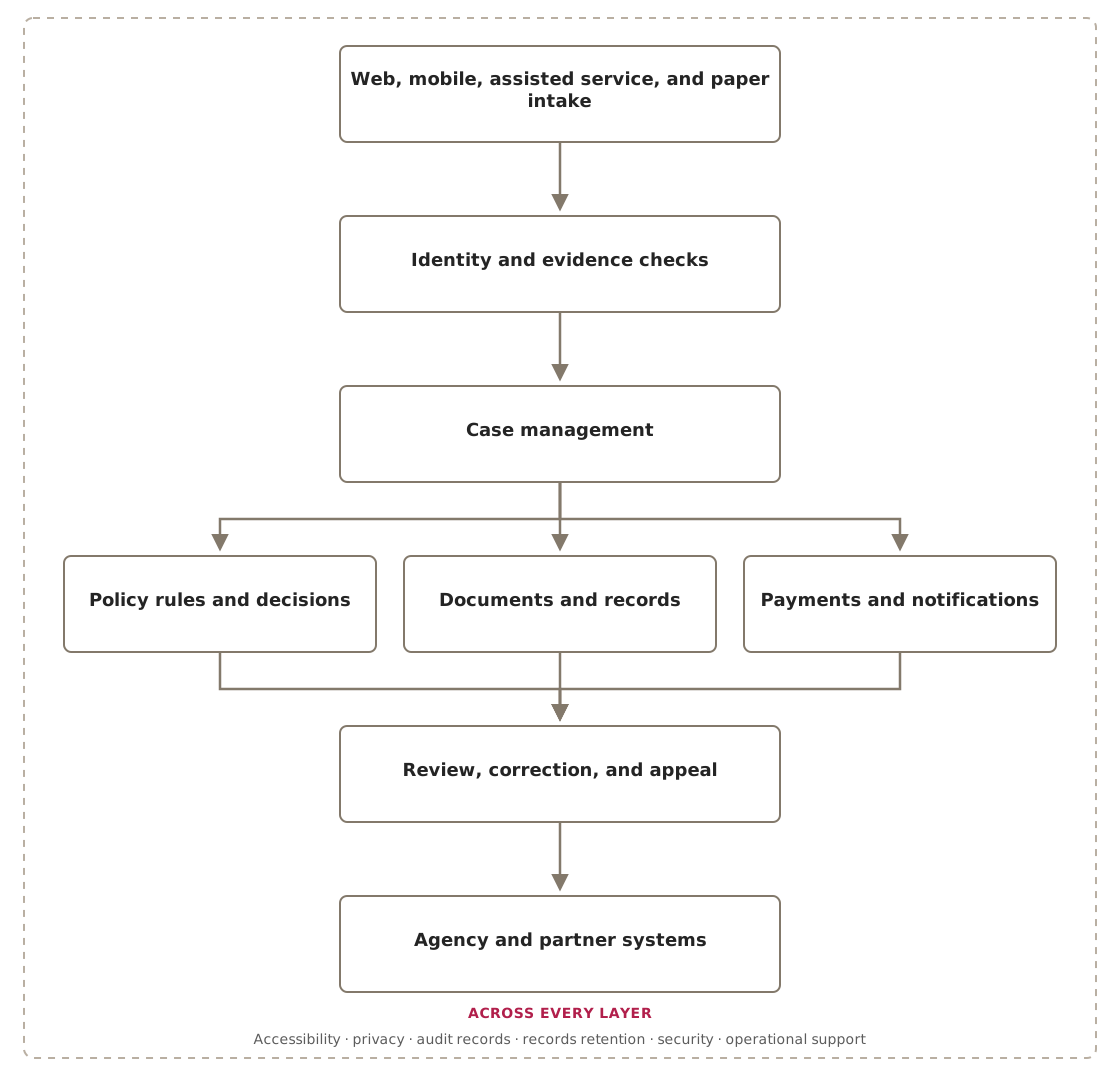
Every channel should reach the same case, policy, and review boundaries. Digital access should improve service without making a website the only route to a right or obligation.
One possible implementation
An accessible, server-rendered web application could use ASP.NET Core services, PostgreSQL for case and policy records, object storage for evidence and issued documents, and Apache Kafka for auditable changes shared with agency systems. OpenAPI contracts can make partner interfaces explicit and testable.
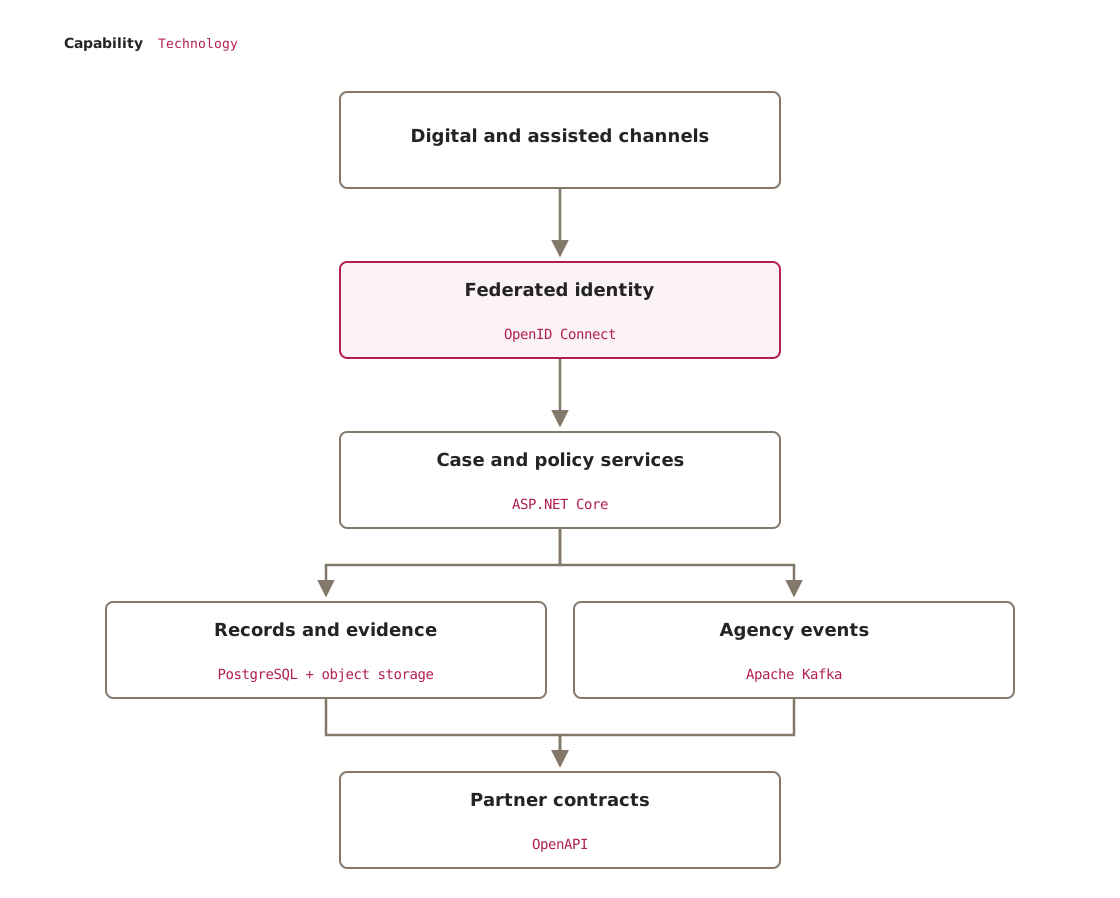
Identity federation can follow OpenID Connect, but assisted and offline channels still need equal access to the same case workflow. Technology selection should follow accessibility, records retention, data residency, appeal, and continuity requirements rather than assuming every service belongs in one digital channel.
Start with the public outcome
Agency boundaries are not citizen journeys. A person may need several departments to complete one life event such as moving, starting a business, having a child, or losing a job.
The service should explain eligibility, required evidence, current status, expected time, decisions, and next steps in plain language.
Identity must not become exclusion
Strong identity proofing can protect benefits and records, but it can also block people with limited documents, changed names, shared addresses, disabilities, or low digital confidence.
Design needs assisted and offline routes, delegated representatives, recovery, fraud controls, and a way to correct identity data. Authentication strength should follow the action rather than burden every visit equally.
Policy needs an executable and explainable form
Eligibility and calculation rules change over time. The system should record which policy version, facts, and evidence produced a decision.
Rules need tests with policy experts, effective dates, controlled rollout, and the ability to recalculate or correct affected cases. A notice should be understandable without reading source code or legislation.
Due process is a product requirement
People need to review submitted information, provide missing evidence, receive reasons, request correction, appeal, and track resolution. Deadlines and service failures should not silently remove rights.
Audit history must preserve both automated and human decisions while restricting access to sensitive records.
Design for everyone and for disruption
Public services must support assistive technologies, multiple languages, low bandwidth, older devices, shared computers, and users under stress. Saving progress for a later return, printable records, assisted channels, and clear timeout behavior must remain available.
Peak events such as deadlines, emergencies, and policy launches require capacity plans, queues that preserve fairness, and communication outside the service itself.
Interoperability needs accountability
Data may cross agencies and contractors. Shared identifiers and APIs can reduce repeated form filling, but access needs legal purpose, minimization, provenance, correction, retention, and clear ownership when records disagree.
Open standards and portable records reduce dependence on one vendor and help public systems remain maintainable over long lifetimes.
What changes with AI agents
An agent could explain eligibility, help complete forms, translate notices, or gather documents. That could improve access, but a wrong answer about benefits, tax, or immigration can cause serious harm.
Official sources, policy versions, citations, and effective dates should accompany generated guidance. Agents may prepare applications, but the person should review declarations before submission. Decisions and appeal rights must not become hidden inside a conversation.
Public access cannot depend on one commercial agent. The direct website, assisted service, and offline route remain necessary for choice, accountability, and recovery.
Try the eligibility decision experiment
The explainable decision lab is a working prototype for applying a versioned policy, preserving the reason for a decision, filing a correction, and resolving an appeal without erasing history. It includes free accessibility and digital-identity resources.
Questions I am wondering about
- What right, obligation, or public outcome does the service support?
- Who is excluded by the identity and digital assumptions?
- Can every decision be explained using the applicable policy and evidence?
- How can a person correct, appeal, or continue through another channel?
- How are access and disagreements between agencies governed?
- Can AI assistance cite authoritative rules without becoming the decision maker?
What I want to remember
Public software should make institutions easier to understand and hold accountable. Efficiency matters, but dignity, access, explanation, correction, and continuity are part of whether the service works.